- Home
- Technical Solutions
- Technical Publications
- Grid Business
- Announcements
- Grid Middleware
- Existing Grids
- Grid Links



By emerging business models we mean those that describe future commercial applications for Grid computing. These models mainly correspond to the emerging B2B environments. A short survey is included in this document. Variants on ASP (Application Service Providers) like IBSP (Internet Business Service Providers) and ISV (Independent Software Vendors) have been identified as models for innovative network-centric applications that may benefit from Grid technologies.
Essentially the ASP model consists of the hiring of applications to customers that do not make the investment required for owning the application. Typical characteristics of an ASP business model are shortly summarised as:
Delivered over a network. This means that the application is not located at the customer site.
Externally managed. The service provider manages the service and the customer is unaware of the details.
One-to-many service. The provider aims at servicing many clients. The customisation must be minimal.
Service-fee-based pricing. The fee may be based on a subscription or on occasions on variable consumption parameters as time, number of users or transaction count.
Contract fulfilment. Usually an agreed SLA guarantees the availability and quality of the service.
Generally speaking, an IBSP is an ASP that develops its own applications specifically for hosting in the web, instead of enabling existing applications for the internet. IBSP provide software as a utility using the pay-per-use subscription model. The end customer does not need to purchase, install, or maintain expensive hardware or software. This saves time, eliminates support costs, and minimizes the hardware expense. IBSP usually embrace multi-tenant hosting, in which a single group of powerful servers delivers the application to all customers, creating economies of scale and lowering costs dramatically. Revenues are directly tied to subscriptions. An IBSP is typically built as a well-designed web site. It is designed specifically for the end user and with the intention that staff training takes only a short time (much shorter that in traditional ASP models). The content is accessed by a web interface that is usually created for anyones use. This way the navigation is greatly simplified. Typical applications accessed by an IBSP are e-mail, ERP and CRM. In the future, entertainment applications such as high-performance gaming by means of grid technologies are expected to follow this model.
Some other envisaged business models are:
Financial online portals where investors can calculate their preferred financial portfolio themselves.
Financial service providers using the grid infrastructure as a resource to sell on-demand customized forecasts of financial portfolios to banks and financial firms.
Figure 1: the envisaged Financial Portfolio Management, as mentioned above
Companies look at Grid as the pooling and efficient utilisation of resources, all accessible through the Internet and coordinated by Virtual Organizations.
Moving beyond concrete representations for ASP processes within a single organization, the targets are open and flexible infrastructures more suitable for dynamic and networked organisations.
ASPs federated in a network (the Virtual Organization) - Grid technologies allow resource sharing across and beyond institutional boundaries, forming a dynamic market that overcomes the limitations of static configurations. This allows the configuration of the service to be changed in order to address unforeseen bottlenecks in real time while still constraining costs. It also allows new services to be created and compiled with reduced time to market
There is no marked distinction between providers and users - The VO embraces all actors because everyone can make their own resources (or a part of them) available for the other involved parties. Naturally, providers and consumers still exist but also consumers contribute to the organization with their own resources and so they obtain a cheaper applications rent fee as payment or even an income for the use of their resources. ASP market players have been identified as the following:
ASP/GSP Providers
ASP Enablers
ASP/Grid R&D
Governmental Institutions
ASP Business Models
Model 1 - ASP as a Grid User
For example, an ASP has an existing system and simply wants to add some peripheral functionality, due to lower switching costs.
- Reduction of the total cost of ownership (TCO) by outsourcing parts of the value chain that can be provided cheaper by using Grid Services through exploiting economies of scale.
- Transparent use of the Grid
- The customer is not interested in understanding the Grid itself as potential part of new business processes.
Model 2 - ASP as a Grid Enabler
Maybe the most promising proposed business model, concerning time-to-market and potential effort/benefit ratio (harvesting the Grid).
- Orchestration of existing Grid services in combination with the legacy system
- Enhanced scalability
- New sophisticated services possible
- Existing client interface can be kept
- Cheap and fast access to Grid Computing facilities (Enabler).
- Improved time-to-market
- Creates new products and acts as service reseller
- Relies on the core competences of other vendors
Model 3 - Grid Service Provider (GSP)
The previous two models rely on this. The competitive advantage is the potentially big imitation barriers, due to higher investments.
- Additional market by selling component services, which need not be completely related to an existing business process.
- It can still act as a classical ASP by providing interfaces to its own clients.
A mobile Grid service provision forms a Virtual Organization (VO). A VO is a form of project oriented collaboration between legally independent enterprises and individuals that combines various parties (persons and organizations), located over a wide geographical area, which are committed to achieving a collective goal or pooling together their core competencies and resources. The partners in a VO are dependent upon an electronic connection or Information Communication Technology (ICT) infrastructure for the coordination of their activities.
The key players involved are the following:
Application Users
Application Provider
Platform Providers and Operators
Service Providers
Content Providers
Technology Providers (Network Technology Provider, Grid Technology Provider, Semantic Technology Provider)
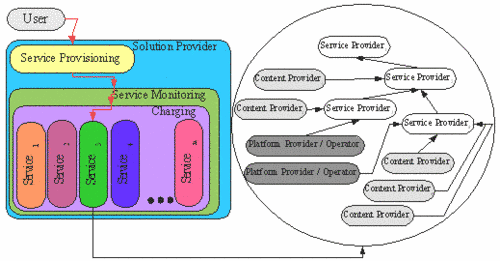
Figure 2: Product model for basic services within a business architecture
This figure identifies basic services within a business architecture. Users can access a specific service using a solution providers infrastructure. Depending on the users level of authorization, the service provisioning entity checks whether and how admission can be granted. Additionally, central entities are in charge of, on one hand, monitoring services in regard of security and QoS (Quality of Service) aspects and, on the other hand, charging for those services consumed. Furthermore, it shows how the entities are involved in the collaborative composition of one service and within their roles assigned.
Financial Flows
A customer using one or more mobile grid services should only receive a single bill. In order to reach this goal there has to be a single centralized financial institution gathering all relevant data from all entities involved. The following parties can be identified:
Organisational units offering mobile grid services:
o Application/Solution Providers: They are in direct contact or have at least a direct relationship with the end-user and are thus the preferably chosen entity to act as the billing issuing party. In contrary, if we suppose having more than one solution provider it seems better to have one specialised organisational unit for charging purposes. Solution providers will have built up relationships to other solution providers as well as to external entities. They will have to compensate them for received services and efforts accomplished. The need for a differentiated billing solution seems obvious with respect to the different kinds of activities to be included.
o Service Providers: In a virtual organization services are often composed not only by an integrated but by a distributed supply chain. Each and every included party concentrates on its respective core competencies in order to achieve a higher increase in value across the whole value chain. Regarding financial flows this means to be in big need of an appropriate charging system which shows high flexibility. All entities have to be repaid for their contributions in terms of CPU (Central Processing Unit) time, network traffic, knowledge access or a complete service for customers.
o Platform Providers: the platform itself can be published as open source software. In that case, it will not serve as a source for earnings directly. Support services and maintenance can be regarded as two prominent examples. Additionally, if a platform provider intends to be partnered with a solution provider and therefore offers services in the role of an actual grid operator, there will be a potential for substantial gains in exchange for outsourcing operations.
o Content Providers: Presumably they will remain self-dependent and thus offer knowledge access through grid services but otherwise focus on their own internal procedures. Of course, they will be paid for granting admission to their managed contents.
Platform external entities:
o Users/Customers: there can be several customer profiles. For example, in case of a hospital as a customer, it will be necessary to have the bill sent to the appropriate address within the customers organisational structure (presumably on behalf of the hospitals accounting department and not on behalf of the hospitals employee who actually used the charged-for service). Customers will stay preferably in contact with one single party as a full solution provider.
o External Service Providers: They are meant to be external organisations offering additional services that are not offered by using a specific mobile grid service, but can be charged to the customers account and afterwards be set on the corresponding bill.
o Technology and Business Consultants: Although they are not directly involved in the process of composing and creating grid services, they can support solution providers or other involved entities by providing means of accumulated knowledge within their respective field. In exchange for their consultancy services they have to receive compensation in this regard.
Generally speaking, for every single service or activity that has to be charged for, mainly onto the customers single bill , there has to be found a common agreement on the following major topics:
What is the product customer is being charged for?
Who determines the product prices? What methods are applied?
How and when will the customer be charged (real-time, with certain delay, on a monthly basis)?
What kind of contracts come into operation (between all the different entities)?
Which payment options are offered to customers (bill, direct debit from a bank account, credit cards, pre-paid solutions, post-paid solutions)?
Who is responsible for supervising, adapting, optimizing financial flows? How is the data being verified?
What can be done in case of conflicts (non-payment, bankruptcy, unsettled disputes)?
An EU-funded, Grid-related project called Assessgrid, deals with designing a customisable, trustworthy, interoperable open-source software for risk assessment, management and decision-support in Grids, there is a brokerage scenario being studied and developed.
The so-called Grid Resource Broker (GRB) the project is working on, is a portal to computational grids, an intermediary between the provider and the end-user (like ebay in e-commerce). There would be an SLA between the user and the broker and another one between the provider and the broker. End-user and provider do not meet. So the financial flows, risk management, other responsibilities must be dealt with accordingly.
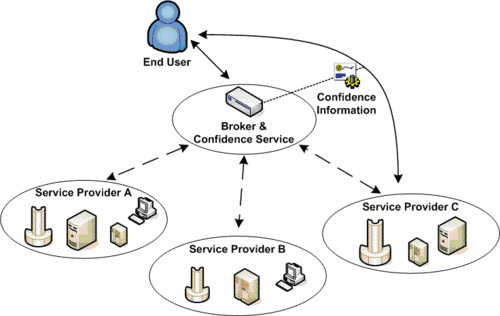
Figure 3: Broker as mediator between service providers and end users
 Print this page