The Grid technology directions currently are focused on enabling:
Convergence on service oriented grids,
Consolidation in grid related standards (WSRF, WSN, WSDM, Service security, Service directory incorporated to OASIS).
Resource abstraction instead of just storage and computing
Interoperability.
Seamless and secure end user access to services
Global scale integrated service based systems and applications.
However, there is an evident need on research to accomplish:
Service discovery, access and security.
Manageability, adaptability and autonomy of service systems.
Service level agreements (SLA), quality of service (QoS) and performance.
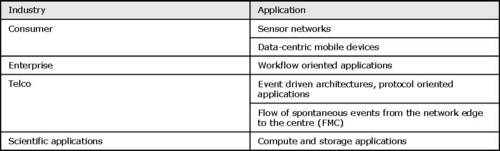
The different industries pose specific requirements. The clearest examples are :
Fixed mobile convergence (FMC) is one of the crucial strategic issues in the telecommunication industry. In this area grid technology and SOA can be used to simplify systems and the network itself. Another research area that the grid technology developers are focusing on, is remote instrumentation enabled by grids. According to the Grid CC workshop held in Helsinki in November 2006:
Grid enabled Remote instrumentation. Integrate instruments into the classic computational/storage grids. The objective is the remote control and monitoring of complex and distributed instrumentation. Tight integration between instrument grids and classical computational grid.
RingGrid (Remote instrumentation in next generation grids). Synergy between remote instrumentation and next generation high-speed communication networks and grid infrastructures. Trend analysis and recommendations for designing next generation remote instrumentation services.
The IST 2006 conference held in Helsinki, Finland, explored the idea that the broadcasting and media industry need to generate, preserve and manage huge quantities of digital content, and that this could be facilitated by the Grid. This was discussed in a session hosted by BELIEF, the Bringing eLectronic Infrastructures to Expanding Frontiers project.
There is a fundamental gap between the technology and its users, particularly those users who will be the main consumers of the services under active development. The technology is still too complex, requiring too much knowledge to use and too much effort to manage. In order to propose market opportunities we can have a look at two approaches: the Next Generation Grids expert group approach and the SCF Associated Ltd report, written by Simon Forge and Colin Blackman, titled Commercial Exploitation of Grid Technologies and service.
Concerning the first approach, in the last quarter of 2005 the Next Generation Grids expert group was involved in identifying the gaps between the leading-edge of Grid technologies and the end-user. In the NGG report it emerged that [1];
"the popularity of Grids has been growing rapidly, driven by the promise that they will dramatically change the life of individuals, organisations and society as much as the Internet has done in the past decade."
Grids can give new drives to the IT market and foster growth and competitiveness in many industrial and business sectors, thanks to the knowledge and computing resources to be delivered to and used by citizens and organisations as traditional utilities or in novel forms.
The complexity of software applications is growing rapidly under the time-to-market pressure. In this view, mainly for cost reasons, it is foreseeable that no single company or organisation would be interested in creating very complex and diverse software applications by itself. Future business and scientific applications will be built as a complex network of services offered by different providers, on heterogeneous resources, constrained by administrative problems when crossing the borders of different organisations, well-known as SOA (Service Oriented Architecture).
The NGG vision consists of three complementary dimensions: the end-user perspective where the simplicity of access to and use of Grid technologies is exemplified; the architectural perspective where the Grid is seen as a large evolutionary system made of billions of interconnected nodes of any type; and the software perspective of a fully programmable and customisable Grid.
Our attention is focused on the end user. So that we can say that product manufacturers in industries such as automotive, aerospace and others have multiple design and engineering challenges when integrating a complex collection of mechanical, electrical, electronics and software components together for design and production of products (e.g. vehicles, engineering systems, and others). Consider a scenario with design engineers, manufacturing specialists, third-party design specialists and suppliers involved in collaborative design and engineering of complex products.
End-users will require personalisation techniques that allow the services and infrastructure to be tailored to their individual needs, including the creation of information and knowledge as well as its delivery.
The socio-economic aspects also demand investigation. Issues of ethics, privacy, liability, risk and responsibility will arise which will impact future public policies. Economic and legal issues will emerge from combining open shared systems with other systems, and new forms of business models will emerge. These studies will require interdisciplinary research.
Concerning the second approach, Simon Forge and Colin Blackman think that the established European exploitation mechanism, in which industrial partner in EC projects invest in the pre-competitive research and then invest in their own commercial products development and support, is unlikely to succeed for grid commercialisation of products and services. They say that it tends to produce a range of competing results rather than one model. It fragments any effort to build a single model.
In order to bridge the gap they propose to have a look to other country experience. An example is the Korean Grid programme. Korea is interested in Grid technology as a way of introducing computing technology to an industrial environment which is strong in semiconductors, telecommunications and display technology but weaker in computing technology, especially software. Grid computing is one important direction for its declared goals of national competitiveness in advanced IT services. Therefore in Korea the business grids projects have concentrated on quite practical application, often linked to telecommunication. Korea is also interested in taking the grid to the level of the ordinary population and has plans on usage of a grid from home. One experiment is Kore@Home project- the development of a software platform for Internet based distributed computing using volunteer computer resources and peer-to peer networking with forms of PKI-based security and digital signature, based on Web Service with SOAP messaging. It aims to dynamically link resources as an ensemble to support the execution of large scale resource intensive distributed applications. Korea Grid strategy is strongly connected to the business directions of its main Telecommunication companies.
The result of the Korean approach is a common model of Koreas technology advances close cooperation between government agencies, industry and academic institution, guided key ministries with much of the co-ordination through an established dedicated organization, the Grid Forum Korea.
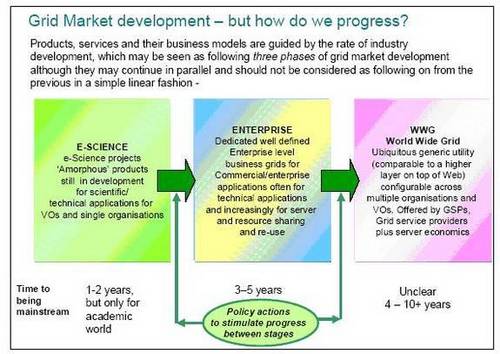
Naturally, the Korean and other Asian models such as Japan are not replicable in Europe. So the SFC Associates have proposed the scheme presented in the following picture:
-
-
Figure 1: Policy actions to seed the next phase of grid market development Source Simon Forge and Colin Blackman, titled Commercial Exploitation of Grid Technologies and service [2]
At the end of this approach, we could summarise some issues for the discussion:
In order to create a European market it could be useful the creation and the promotion of a standard toolkit and a reference model with support service. It could be chosen among the best technologies/middleware available at the moment. These common toolkit elements can be diffused to the European software industry, which may use it as a basis for Grid technology commercialisation in products and services and to the user/enterprise /consumer market that may use it directly. In this model the spread of grid technology is left to the market, to create an offshoot of the software and internet services industry in derived product and services which can run over the Internet, or in more secure infrastructure.
From the Policy point of view, it could be possible to build an open grid infrastructure for grid application services.
From the end user point of view a European Agency for Grid technology and a core set of market support unit could be useful for the market.
Marketoriented R&D: on the model of EUREKA programme, that aims to enhance Europe competitiveness trough its support to business, research centres and universities who carry out pan-European projects to develop innovative products, processes and services. The federations charter should be set with a long-term programme of focused targets, producing projects, standards negotiation support, analysis and promotional material following the strategic direction for the development of EU grid middleware and its commercial exploitation. This Special Grid Group could later have a global extension.
This material is taken from the document "Market Watch" produced by the BEinGRID project.
For further information see:
[1],
[2],
http://www.isgtw.org/?pid=1000196
,
http://www.isgtw.org/?pid=1000196
,
and
http://www.semanticgrid.org/documents/ngg3/ngg3.html
.



 Print this page