GRIDipedia The European Grid Marketplace
While big businesses have been using Grid for years to speed up compute-intensive applications and handle huge volumes of data, since Grid began its evolution, enterprises have been finding more everyday uses for Grid technology, focusing more on Grid's inherent flexibility and distributed nature than on its brute processing power. One way in which they have been using Grid is to handle transactional applications, a technology trend Gartner has labelled "Grid-based application platforms," which, as of July of 2006, sat in the "Technology Trigger" area of Gartner´s Hype Cycle. (The first phase of a hype cycle is the "technology trigger" or breakthrough, product launch or other event that generates significant press and interest.)
-
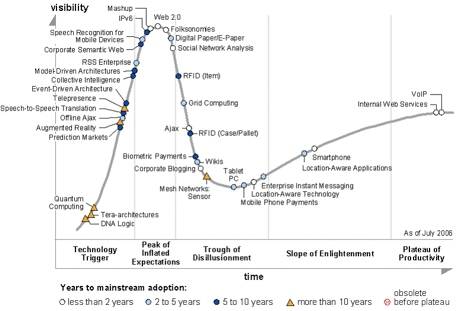
- Figure 1: The positioning of Grid technology adoption expectations among other technologies
If we check the following technology radar, we can see that the expected impact of Grid on service business is of medium strength and the timeframe is approximately 2 years from now.
-
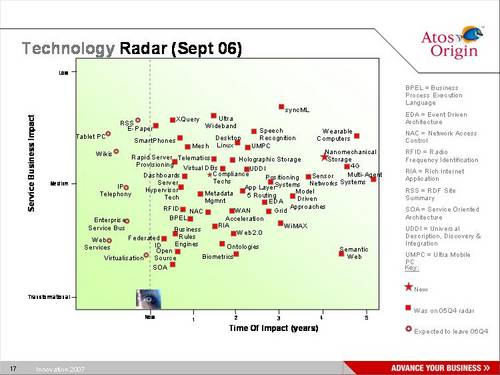
- Figure 2: Grid Technology Radar
According to Massimo Pezzini, vice president at Gartner, while there are similarities between traditional Grid deployments and Grid-based application platforms, and while the underlying technologies even can be the same, the target, from an application perspective, is different. "In traditional Grid, the problem is allocating processing power and you don't really care about availability of the overall system, if one box is available you don't care. You need to have that server," he said. "In transactional applications, it is not that simple. With transactional applications, you have to deal with databases, you have to deal with maintaining the transactional integrity of the thing that you are doing. Its a bit more complicated.
Typically, these Grid-based application platforms address two main problems that are not always for traditional grids to solve: scalability and availability. When it comes to scalability, it's all about adding more and more hardware resources, , and availability is crucial because users need to be able to maintain transactional integrity, which generally requires as close to 100 percent availability as possible - even while adding or removing resources from the Grid.
And it is here, where vendors believe they have the advantage over traditional Grid vendors. Whereas Grid-based application platforms can be applied to straight computational applications, the same cannot be said for traditional grids and transactional applications. Among the vendors trying to exploit this different approach -- according the hype cycle profile -- are GigaSpaces, Appistry, Paremus, Aumega Networks and Majitek, of which Pezzini cites GigaSpaces as being the largest in terms of revenue and customer installations.
A representative of Appistry said: "Grid plainly has a lot of advantages to offer the enterprise for business-oriented types of applications, and that process of migrating from Grid middleware or Grid scheduler to Grid-based application platforms is really the key."
Taking a step further, supported by several sources, in the Grid market, future developments will be impacted by the convergence with other new technologies, such as Service-oriented Architectures, Web services, Semantic web, among others. For instance, Grid middleware may serve as proper underlying platform for these technologies, being grids perceived as the technology infrastructure and e.g. SOA as the application infrastructure. Actually, it is a process that has already started. At a certain point, this may create a competitive situation to the actual grid middleware market as grid functionalities and benefits might be integrated and provided by other applications and solutions. SAP, for instance, plunged into the SOA pool, launching a whole adoption program that provides a set of services and associated accelerators to facilitate a successful implementation of its SOA products (enterprise SOA, NetWeaver, Ecosystem). No need to add that SAP is also active in Grid activities.
So basically from an enterprise applications point of view - it may be said that it is not around creating new Grid services, but about putting existing applications onto a managed, shared infrastructure.
There are many existing systems that could work more efficiently with Grid. For example, the logistics scenario, where RFID has squeezed in, and together with transport features and other logistics-related systems will produce huge amounts of information and these resources have to be handled in an efficient way: with Grid.
Or in the automotive industry, modern technology is willing to implement sensors in the cars to get a lot of data and information about the different parts of the cars, thus control different aspects, which would mean for car fleet management for instance- millions of calculations waiting to be handled by the Grid, as it were.
Let´s take the telecommunications industry as an example. A near future scenario of the telco service providers is seem to be the provision of computing services. There is old news just to offer powerful bandwidth, internet access through mobile devices, or cable television. They need to get new competitive advantage as there is a strong competition on the market. Here come computing services into the picture, but how? With Grid?
All these scenarios, and much more, are leading to the same conclusion, as was mentioned before: it is not really around creating new Grid services, but about putting existing applications onto a managed, shared infrastructure.
To talk in the same language that technology trends, software and services are using, like Web 2.0, Globalization 3.0, Wikipedia 3.0, 3G, 4G, among others, here you have an interesting piece:
We are a society that is obsessed with putting labels, signs or numbers on everything (trends, movies, products, etc.) The 451 Group defines the Grid versions as follows: Grid 1.0 is principally concerned with the virtualization, aggregation and sharing of compute resources, Grid 2.0 is focused on the virtualization, aggregation and sharing of all compute, storage, network and data resources. It is both service-oriented - it uses Web services and provides access to IT as a service - and automated.
This material is derived from work published in GridToday, December 11, 2006.
www.gridtoday.com/grid/1150800.html
© 2007 BEinGRID