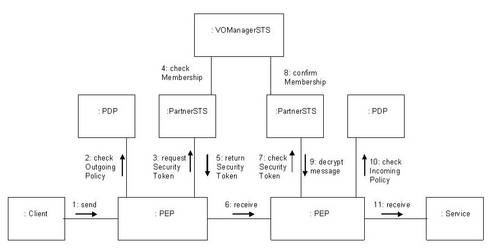
Members of a federation must be able to identify one another, identify messages as coming from other members of the federation, and identify the truth of claims made by other parties in the federation. For example, Partner B receives a request from Partner A to perform a unit of work on a grid server. Partner B needs to identify that the message comes from Partner A and that it is a member of a federation.
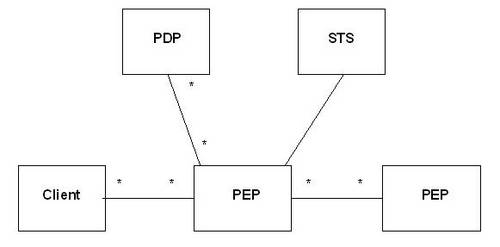
There can be two different types of STS. The partner-level STS implementation is targeted to VO participant organizations, i.e., a partner-level STS is responsible for issuing security tokens that are used to secure messages that originate in this VO participant organization. The second type is the VO-wide STS. Its purpose is to issue VO-internal security tokens and claims, in particular membership claims. This VO-wide STS is tightly coupled to the VO membership database in order to testify membership information in the form of claims.
It is also possible to have partner STSs talk directly to each other. Algorithms exist for performing token exchange without the third party.
Note that the above sequence would obviously change where a VO-level STS is not used. The two partner STSs (client and service) would communicate directly.
© 2007 BEinGRID