When interacting entities are exposed via Web Services interfaces and can understand WS-Trust and WS-Coordination standards.
For establishing on-the-fly mechanism to dynamically bootstrap or exclude participants of the collaboration.
- To provide a security baseline for a distributed transaction of Web services, which is independent of the transactions business logic, where transactions can be of varied nature (atomic transaction, business activity, or business process).
- When the requestor directly invoking a service does not know/have in advance the specific rights and privileges required for the interaction.
-
When:
- Dynamic federative collaborations of participants belonging to different enterprises is required.
- Collaborative group needs to be secure from outsiders, and from past members; also, group; members must not be able to talk to outsiders in the context of the group.
- Mechanism needs to provide peer-authentication and authorisation, and message confidentiality and integrity.
- Participants may be introduced dynamically, which has to be done in a secure way.
- Past group members are prevented from interactions within the group, by: their (SOAP) interceptor is re-configured, and the security context of the group is updated.
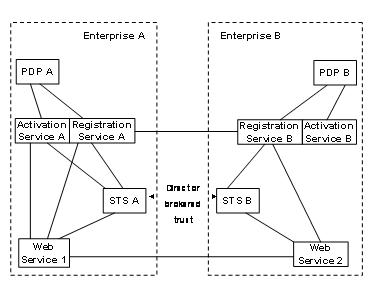
The architectural model assumed in the pattern is depicted in the next Figure - Secure Federation.
The initial assumption is that every entity in the model already owns a key pair and an identity token provided by the environment (i.e. a trust realm) they reside in. A token contains owners ID, public key, etc. These tokens can be attached to every message when authenticating a requester at the destination is required.
As an example, an identity token owned by web service 1 is:
Tws1 = (WS1_ID, Puws1,
) signPrsts
,where WS1_ID is the identifier of the service1.