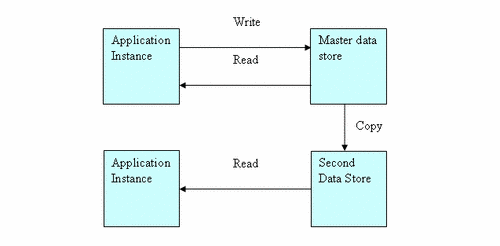
Another important capability that is required by some businesses is to maintain the same information in multiple different locations. The goal is to have all of these sources containing the same data. Having this allows more users to access the data while reducing the risk of a bottleneck occurring and it also provides redundancy if one of the systems goes down. It also allows multiple different companies to share information, reducing the amount of work required to enter information into both systems.
Again, there are a number of possible ways of doing this depending on what you are trying to achieve, for simplicity these examples will refer to only 2 data sources, but the same principle could be extended to more.
The simplest scenario is one where you have one data location set up to allow read/write access to the data. A second data store is then used as a back up. It performs all the operations of the first data store, but only takes over for read and write operations from the user if the primary fails.
-
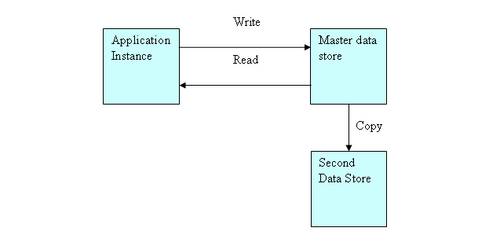
- Synchronising multiple data sources