The World Wide Web Consortium (W3C) ( www.w3.org ) is an international consortium where member organizations, a full-time staff, and the public work together to develop Web standards. W3C's mission is:
To lead the World Wide Web to its full potential by developing protocols and guidelines that ensure long-term growth for the Web.
During the 2006 W3C ratified the WS Addressing 1.0 as a standard.
Web Services Addressing 1.0 Core, Web Services Addressing 1.0 SOAP Binding
It introduces a way to specify the destination address, promotes asynchronous message exchanges and allows more than two services to interact.
Web Services Addressing 1.0 WSDL Binding (Candidate Recommendation)
OASIS (Organization for the Advancement of Structured Information Standards) ( www.oasis-open.org ) is a not-for-profit, international consortium that drives the development, convergence, and adoption of e-business standards. The consortium produces more Web services standards than any other organization along with standards for security, e-business, and standardization efforts in the public sector and for application-specific markets. Founded in 1993, OASIS has more than 5,000 participants representing over 600 organizations and individual members in 100 countries.
The mission of OASIS is to drive the development, convergence, and adoption of e-business standards. This mission shapes the policies, processes and programs that directly affect OASIS members, and also affects how OASIS works with non-member constituents. Non-members include organizations or individuals that comment on proposed or existing standards, and that implement or recommend their use.
During 2006:
OASIS approved the WS-Notification as a standard. The target was to standardize the way Web Services interact by means of Notifications and Events. This enables the dissemination of information among web services without having a previous knowledge on them.
OASIS approved WS-Security version 1.1 as an OASIS Standard. WS-Security delivers a technical foundation for implementing security functions such as integrity and confidentiality in messages implementing higher-level Web services applications.
OASIS approved the Web Services Resource Framework (WSRF) version 1.2 as an OASIS Standard. WSRF provides a generic, open framework for modeling and accessing stateful resources using Web services. The WSRF OASIS Standard comprises a set of royalty-free, interoperable, and modular specifications that make it easier both to define and implement a Web service and to integrate and manage multiple services.
The European Telecommunications Standards Institute (ETSI) ( www.etsi.org ) is one of the three European Standards Organizations and is officially responsible for standardization of Information and Communication Technologies (ICT). It cooperates with other regional standards bodies in this field. It has 500 industrial members throughout Europe.
Its output includes standards which pass through a wide consultation process and also New Regime outputs which follow a fast, restricted approval procedure. It is an organizational partner in 3GPP and adopts its output.
The TC (Technical Committee) GRID is responsible for ETSIs contribution to Information Technology (IT) and Telecommunications convergence standards in the GRID domain. It is in charge of writing test specifications and progressing towards a broader range of GRID standards in order to integrate the use of telecommunications infrastructures in networked computing. Interoperability is the target.
The Open Grids Forum ( www.ogf.org ) has been recently formed as a result of a merger between GGF and EGA. The merger formally took place on 11th September 2006. OGF's mission is to accelerate grid adoption to ensure business value and scientific discovery. The Open Grid Forum (OGF) is the community of users, developers, and vendors leading the global standardization effort for grid computing. The OGF community consists of thousands of individuals in industry and research, representing over 400 organizations in more than 50 countries. They work for the pervasive adoption of grid computing worldwide in order to lead to new discoveries, new opportunities, and better business practices.
The work of OGF is carried out though community-initiated working groups, which develop best practices and specifications in cooperation with other leading standards organizations, software vendors, and users.
The model of Research Groups, Community Groups and Working Groups is inherited from GGF, but they are now grouped into 3 major functions: eScience, Enterprise, and Standards (http://www.ogf.org/gf/group_info/areasgroups.php ).
OGF leads the pervasive adoption of grid computing in research and industry by:
defining grid specifications that lead to broadly adopted standards and interoperable software
building an international community for the exchange of ideas, experiences, requirements and best practices.
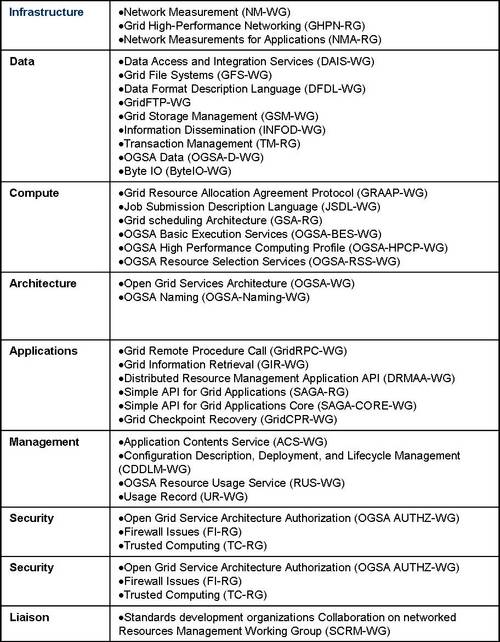
During 2006 the following standardization documents have been produced in different standard function groups.
Data group (Target: Provide standards for the development of grid database services)
Web Services Data Access and Integration The Relational Realisation (WS-DAIR) Specification, Version 1.0
Specification for a collection of data access interfaces for relational data resources. The basic interfaces described in WS-DAI documentation are extended to provide access to relational data resources, which are assumed to be composed of tabular data structures. These are commonly accessed using SQL queries.
Web Services Data Access and Integration The XML Realization (WS-DAIX) Specification, Version 1.0
Specification for a collection of data access interfaces for XML data resources. The basic interfaces described in WS-DAI documentation are extended to provide access to XML data resources and to provide description of such databases.
Web Services Data Access and Integration The Core (WS-DAI) Specification, Version 1.0
Specification for a collection of generic data access interfaces which are made available as web services. It provides a pattern for data service interfaces and the properties that describe or modify the behaviour of those interfaces.
Management group (Target is to cover the management of essential grid operating components)
Application Contents Service Specification 1.0
The document is intended to define a standardized way to manage and handle Application Contents as a deployable logical unit and to define a standard format of Application Archive so as to simplify management processes and automate the administration of application.
Configuration Description, Deployment and Lifecycle Management (CDDLM) Deployment API
API for callers to deploy services described in the component model languages. It must support remote access for deployment, terminating existing deployed systems.
Configuration Description, Deployment and Lifecycle Management (CDDLM) Component Model v 1.0 Deployment API
Definition of the language to describe the components and the systems that are required to configure, instantiate and destroy a Grid Resource.
Architecture group (Target is to define architectures for grid computing).
OGSA WSRF Basic Profile 1.0
The document aims at defining the basic profile, which is intended to be used when implementing services that are concerned with distributed resource management and grid computing or other purposes that involve the modelling and management of stateful entities. These services make use of interfaces and behaviours defined in WS-Addressing, WS-Resource Framework and WS-Notification families of specifications.
The OGSA WSRF Basic Profile 1.0 consists of a set of de facto, institutional or evolving institutional Web services specifications, along with clarifications, refinements, interpretations and amplifications of those specifications that promote interoperability among implementations of the basic profile.
The WS Agreement Specification. is being developed by the participants of the GRAAP (Grid Resource Allocation and Agreement Protocol) WG of the Compute Area of the OCF.